Frequencies
Ten numbers.
Ten shapes.
From 396 to 963 hertz. Where each number comes from, what people attribute to it — and what actually happens to the music when you switch.
Drag the slider. The figure isn't cross-faded, it's calculated — what you see follows the same formula as a real Chladni plate.
Verdi Tuning
The machine
The frequency gearbox
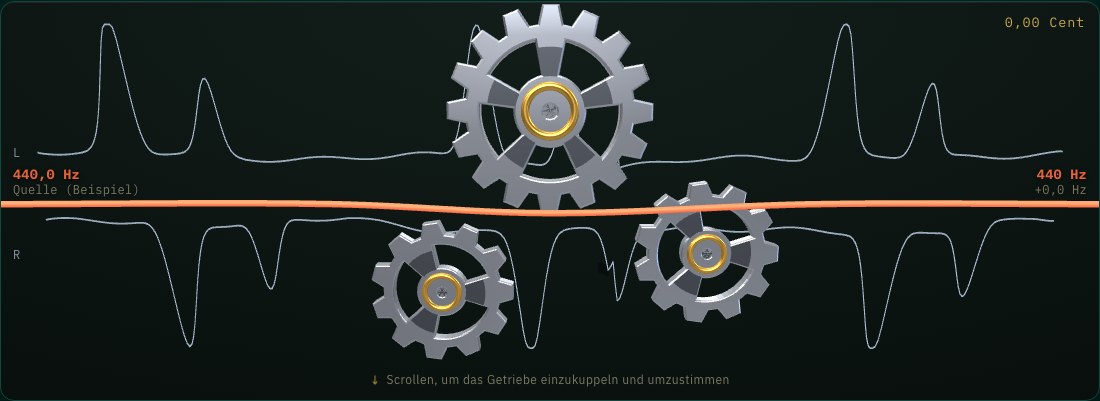
0,00 Cents measure small pitch differences: 100 cents make a semitone, 1 cent is barely audible. More about cents →
440,0 HzSource (example)
440 Hz±0,0 Hz
L RSchematic illustration. In the app, the retuning is set immediately; small changes in the measured music are followed slowly.
Rendering from the app — the curve here is a demonstration; in the app it shows the real, measured sound.
All ten, as the ear hears them
Plotted in Cents measure small pitch differences: 100 cents make a semitone, 1 cent is barely audible. More about cents → relative to 440 Hz — the unit the ear actually reckons in. A semitone is 100 Cents measure small pitch differences: 100 cents make a semitone, 1 cent is barely audible. More about cents → , an octave 1200.
Reference pitches
Three tunings that sit close together
This is about retuning, not transposing: less than fifty Cents measure small pitch differences: 100 cents make a semitone, 1 cent is barely audible. More about cents → — half a semitone — separates the lowest and highest of these three. The piece stays where it is and only changes its color.
Solfeggio
Seven numbers with a history of their own
Their names go back to the solmization syllables of Guido of Arezzo (11th century). The numbers themselves are far more recent: assigning fixed hertz values to those syllables is a modern practice, not a medieval one. Chosen as a tuning reference, they shift the music considerably further — each page states exactly by how much.
Hear the difference.
The numbers are half the story. The other half, you hear for yourself.